AI in 2026 needs government regulation before cyber and bio risks outrun safety
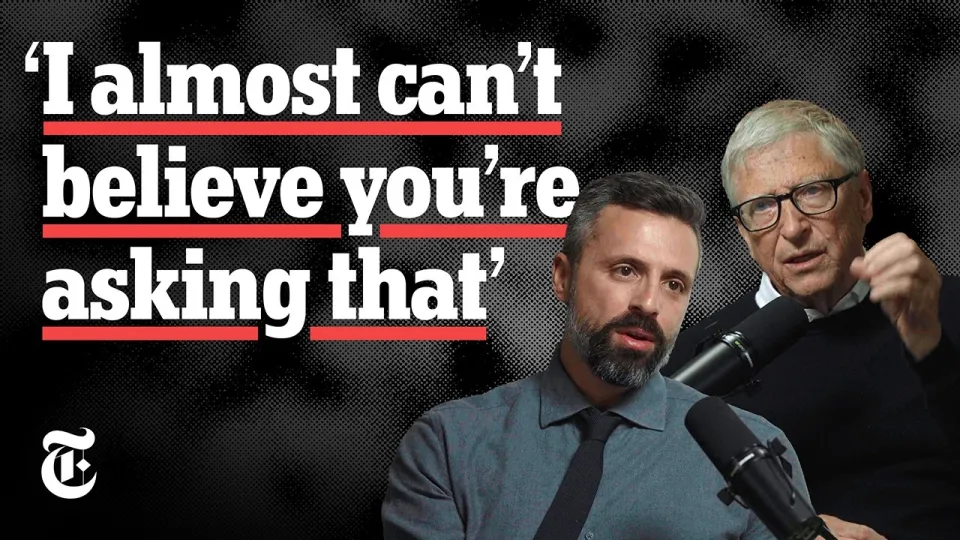
Video: Bill Gates: A.I. ‘Makes Nuclear Weapons Look Like Nothing’ | The Ezra Klein Show
You can order the same kind of articles for your own video to boost it on YouTube and Google. Just message the Telegram bot @sat_sit_bot. It writes articles around your video, embeds the video and publishes them on popular niche websites (no ads). Your first 50 articles are free.
AI in 2026 is no longer a question of whether the technology is powerful enough to matter, but whether governments will regulate it before the worst consequences arrive. That is the core argument Bill Gates makes in a conversation with Ezra Klein, and it is blunter than his past public positions: he calls industry self-regulation "insane" and says AI is the most dangerous technology humans have approached. The full episode and transcript are available through The Ezra Klein Show page on NYT Opinion.
What Bill Gates now believes about AI risk
Gates has moved from cautious optimism to open alarm, and the shift is the frame for everything else in the interview. He describes a near-term window in which AI systems become superhuman at specific tasks, and he argues that the people in positions of authority are largely in denial about what that means. The conversation repeatedly returns to a simple point: the capability curve is steepening faster than the institutions meant to contain it.
His language is unusually direct for a technologist of his generation. He does not treat catastrophic scenarios as science fiction or as a problem for the next decade. He treats them as engineering and policy problems with deadlines, and he is visibly frustrated that the deadlines are not being taken seriously.
Cyber and bio thresholds are the concrete danger
The most specific warning in the episode concerns two domains where AI lowers the barrier to mass harm: cyberattacks and biological weapons. Gates argues that AI makes it easier for smaller, less sophisticated actors to do damage that previously required state-level resources, and that the threshold for a catastrophic event is closer than most policymakers assume.
This is why he rejects the idea that liability and lawsuits can substitute for regulation. His argument, roughly, is that a legal remedy after the fact is meaningless if the harm is measured in millions of lives. Regulation has to operate before deployment, not after a disaster.
Why self-regulation fails
Gates calls the notion that AI companies will police themselves "insane," and the reasoning is structural rather than personal. Competition pushes labs to ship capabilities first and worry about safeguards second, and no individual company can unilaterally slow down without losing ground to rivals. Self-imposed rules therefore tend to be weakest exactly where risk is highest.
He contrasts this with other regulated industries where pre-market testing and independent oversight are normal. The implication is that AI labs should face something closer to that model, with external audits and government-set thresholds rather than voluntary commitments.
The race with China does not argue for less safety
A common objection is that regulation hands an advantage to competitors, particularly China. Gates treats this as a false trade-off. Safety standards, in his framing, are part of what makes an AI ecosystem trustworthy, and a race without rules produces risk for everyone rather than advantage for anyone.
The practical question is coordination: which thresholds get set, who verifies compliance, and how countries avoid a downward spiral in which each relaxes oversight to keep pace. Gates does not offer a finished treaty design, but he is clear that the answer is not to wait.
Jobs, inequality and a no-scarcity labor market
Gates expects AI to disrupt work at a scale that existing safety nets are not built for. He discusses the possibility of a job market where scarcity of labor is no longer the organizing principle, and he raises policy tools that would have sounded fringe a few years ago:
- Taxing AI labor as a way to fund the transition.
- Defining "human reserved" jobs where people are required by law or preference.
- Rethinking income support for workers whose skills are displaced faster than retraining can absorb.
He also ties this to global inequality. The Gates Foundation has made AI-driven inequality a new priority, alongside its plan to spend down roughly $200 billion over the next two decades. His concern is that the benefits of AI concentrate in rich countries and among those already positioned to use it, while developing economies absorb the disruption without the upside. Language technology is one area he sees as genuinely leveling, since AI can extend access to services and information across languages that markets never served.
What viewers keep asking about the interview
The reaction to the episode clusters around a few recurring doubts, and they are worth addressing directly because they reflect real gaps in the public debate.
Is Gates exaggerating? His track record includes both accurate early calls and overly optimistic ones, so the fair reading is to weigh the specific claims. The cyber and bio warnings are the ones with the clearest mechanism and the shortest timeline, which is why they carry the most weight.
Can't markets and lawsuits handle this? This is the position Gates pushes back on hardest. Liability works when harm is bounded and traceable; it does not work when a single failure is catastrophic and irreversible.
Why is he so agitated? Viewers noticed it too. The frustration appears to come from watching capable people dismiss risks he considers well-evidenced, which is a different posture from ordinary pessimism.
What about children and education? Gates addresses AI in schools and the case for specific protections for minors, arguing that defaults and age-appropriate rules matter more than blanket bans.
Useful links
- Full episode and transcript of the Bill Gates conversation
- Book recommendations from guests of The Ezra Klein Show
The bottom line on AI regulation
The Gates interview is less a prediction than a warning with a schedule attached. AI capability is advancing faster than the oversight meant to catch failures, and the two domains where that gap is most dangerous are cyber and bio. Self-regulation, in his account, is not a serious answer, and the race with China is not a reason to delay. What remains open is whether governments build pre-deployment oversight in time, and how they handle the labor and inequality shock that arrives alongside it. This analysis is based on the conversation published by The Ezra Klein Show, and the full discussion is worth reading or listening to in full via the episode page.
Key takeaways
- Gates calls the idea that the AI industry can self-regulate "insane" and says government action is the only credible brake on catastrophic risk.
- He warns that AI-enabled cyberattacks and bio-terrorism could cross dangerous thresholds within a few years, not decades.
- Gates Foundation plans to spend down roughly $200 billion over the next two decades, with AI-driven inequality named a new priority.
- He predicts mass job disruption and floats ideas like taxing AI labor and "human reserved" roles as policy responses.
- The race with China is framed as a reason to regulate faster, not slower, since safety standards become a competitive asset.
Source: Bill Gates: A.I. ‘Makes Nuclear Weapons Look Like Nothing’ | The Ezra Klein Show · Markdown version
Questions & answers
Why does Bill Gates say AI self-regulation is insane?
He argues that competitive pressure pushes AI labs to release capabilities before safeguards are ready, and no single company can slow down without losing ground. Voluntary commitments therefore tend to be weakest where risk is highest, which is why he wants external oversight before deployment.
What are the cyber and bio thresholds Gates warns about?
He means points at which AI lowers the barrier to mass harm enough that smaller actors can cause damage once reserved for states. In his view those thresholds are close, which makes after-the-fact lawsuits an inadequate remedy.
Does the race with China mean AI regulation should wait?
Gates treats that as a false trade-off. He argues safety standards make an AI ecosystem more trustworthy and that a race without rules creates shared risk rather than advantage, so coordination on thresholds matters more than speed.
How does Gates propose handling AI job losses?
He discusses taxing AI labor to fund the transition, defining human reserved jobs, and rethinking income support for displaced workers. He also frames AI-driven inequality as a new priority for the Gates Foundation, which plans to spend down roughly $200 billion over two decades.